
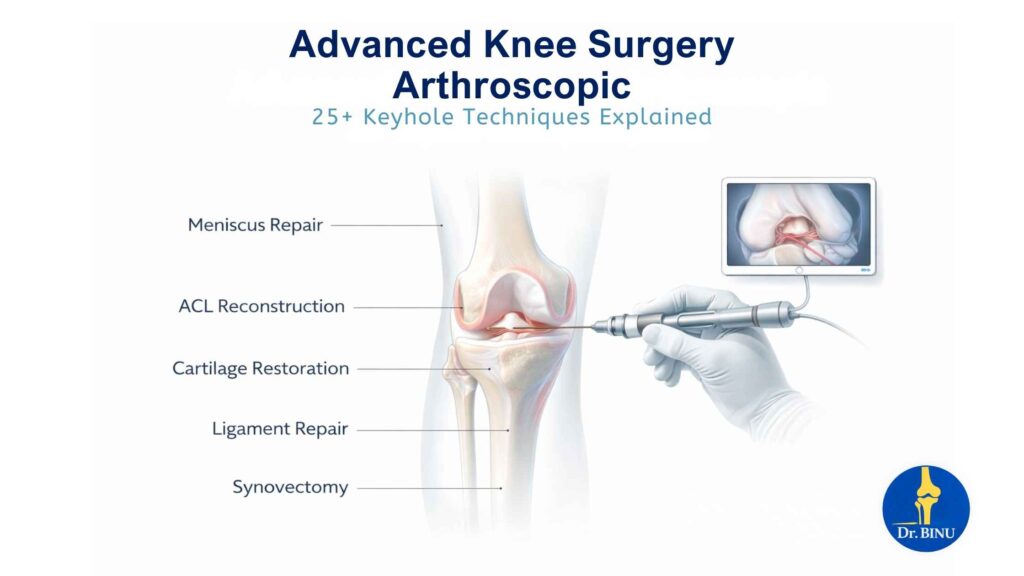
Advanced knee surgery arthroscopic refers to minimally invasive orthopedic procedures performed through tiny keyhole incisions using a camera and specialized instruments. These techniques allow surgeons to diagnose and treat knee injuries with exceptional precision, less tissue trauma, and faster recovery compared to traditional open surgery.
At NMC Specialty Hospital, Electra, Abu Dhabi, Dr. Binu Sasidharan Neelakantan, a highly experienced Specialist Orthopaedic Surgeon with more than 20 years of expertise, performs advanced arthroscopic procedures to treat ligament injuries, meniscus tears, cartilage damage, sports injuries, and degenerative knee conditions. His patient-focused approach, combined with international training in arthroscopy and arthroplasty, ensures safe and effective treatment tailored to each patient’s mobility goals.
What is knee surgery arthroscopic?
knee surgery arthroscopic is a minimally invasive surgical technique in which a tiny camera called an arthroscope is inserted into the knee joint through a small incision. The camera displays real-time images on a monitor, allowing the surgeon to repair damaged tissues using specialized instruments inserted through additional small portals.
This procedure is often referred to by several related terms such as knee scope, microscopic knee surgery, and endoscopic knee surgery. Regardless of terminology, the goal remains the same: accurate diagnosis and targeted treatment of knee problems with minimal disruption to surrounding tissues.
- Small incisions (typically 5–10 mm)
- Reduced post-operative pain
- Faster recovery and rehabilitation
- Shorter hospital stay
- Improved surgical precision
Why choose minimally invasive knee surgery?
Modern orthopedic care increasingly favors minimally invasive techniques such as scopic knee surgery because they provide excellent visualization of the joint while minimizing surgical trauma. This approach is particularly beneficial for athletes, active individuals, and patients who want to return quickly to normal activities.
Procedures such as arthro knee surgery and small knee surgery allow surgeons to treat complex knee injuries while preserving surrounding ligaments, muscles, and cartilage. The use of advanced imaging systems and specialized instruments enables surgeons like Dr. Binu Sasidharan to deliver highly precise treatment.
Conditions treated with arthroscopic knee procedures
Advanced arthroscopy can diagnose and treat a wide range of knee conditions. Many patients benefit from minor arthroscopic knee surgery that corrects mechanical problems within the joint before they progress into severe damage.
Common conditions treated
- Anterior cruciate ligament (ACL) tears
- Meniscus tears
- Cartilage damage
- Patellar instability
- Synovitis and joint inflammation
- Loose bodies within the knee joint
- Early osteoarthritis
- Sports-related knee injuries
In many cases, what used to require open surgery can now be treated using knee surgery microscopic techniques that allow surgeons to repair structures through tiny portals.
25+ advanced keyhole techniques used in knee arthroscopy
Modern arthroscopy includes numerous surgical techniques designed to treat specific knee problems. Below are more than 25 commonly used procedures performed during advanced knee surgery arthroscopic.
Ligament reconstruction techniques
- ACL reconstruction
- PCL reconstruction
- Collateral ligament repair
- Double bundle ACL reconstruction
- All-inside ACL repair
Meniscus preservation and repair
- Meniscus repair
- Partial meniscectomy
- Meniscus root repair
- Meniscus transplantation
- Meniscal scaffold implantation
Cartilage restoration procedures
- Microfracture surgery
- Osteochondral autograft transfer
- Autologous chondrocyte implantation
- Cartilage debridement
- Subchondral drilling
Joint preservation procedures
- Synovectomy
- Loose body removal
- Plica excision
- Patellar realignment
- Lateral release surgery
Advanced arthroscopic innovations
- Biologic cartilage augmentation
- Stem cell–assisted cartilage repair
- PRP-enhanced ligament healing
- Minimally invasive osteotomy assistance
- Advanced imaging-guided arthroscopy
These procedures represent the evolution of ultra scopic knee surgery, where technology enables surgeons to perform highly complex repairs through extremely small incisions.
Understanding different terms for arthroscopic procedures
Patients researching knee treatment often encounter different names describing similar minimally invasive procedures. The table below clarifies how these terms relate to modern arthroscopy.
| Term | Explanation |
|---|---|
| knee scope | Common term referring to arthroscopic visualization of the knee joint using a camera. |
| microscopic knee surgery | Describes procedures performed with magnified visualization through small incisions. |
| knee surgery microscopic | Another variation describing minimally invasive techniques using high-resolution imaging. |
| arthro knee surgery | Short form referring to arthroscopy-based knee surgery. |
| scopic knee surgery | Informal term referring to surgery performed using a scope. |
| endoscopic knee surgery | Technique using endoscopic equipment to visualize and treat joint structures. |
| small knee surgery | Highlights the small incisions used during arthroscopy. |
| minor arthroscopic knee surgery | Used when procedures are limited to minor repairs or diagnostic work. |
Occasionally, variations such as author scopic knee surgery may appear in online searches due to spelling variations or automated search suggestions. In clinical practice, these terms typically refer back to arthroscopic knee procedures.
How arthroscopic knee surgery works
The procedure usually follows several key stages to ensure safety and surgical accuracy.
Step-by-step surgical process
- Pre-operative imaging and evaluation.
- Administration of regional or general anesthesia.
- Creation of small portals around the knee joint.
- Insertion of the arthroscope for visualization.
- Use of miniature surgical instruments to repair tissue.
- Joint irrigation and inspection.
- Closure of incisions using small sutures.
This structured approach allows surgeons like Dr. Binu Sasidharan to perform highly precise endoscopic knee surgery while preserving healthy tissue.
Benefits of arthroscopic knee surgery
Advanced microscopic knee surgery techniques offer several advantages compared with conventional open procedures.
- Minimal scarring
- Reduced risk of infection
- Shorter hospital stay
- Faster rehabilitation
- Improved joint visualization
- Lower post-operative discomfort
For athletes and active individuals, procedures such as knee scope surgery can significantly reduce downtime and help restore normal joint function sooner.
Recovery and rehabilitation after knee arthroscopy
Recovery timelines vary depending on the specific procedure performed. While some minor arthroscopic knee surgery cases allow patients to walk the same day, more complex ligament reconstruction procedures may require structured rehabilitation.
Typical recovery milestones
- Day 1–3: controlled swelling and early mobility
- Week 2: improved range of motion
- Week 4–6: progressive strengthening exercises
- Month 3–6: return to sports activities (depending on injury)
Through careful rehabilitation planning, patients undergoing small knee surgery often regain full joint function and mobility.
Why choose Dr. Binu Sasidharan for knee arthroscopy in Abu Dhabi?
Dr. Binu Sasidharan Neelakantan is a Specialist Orthopaedic Surgeon based in Abu Dhabi who focuses on advanced arthroscopic procedures and joint reconstruction. With more than two decades of surgical experience, he provides comprehensive orthopedic care for sports injuries, degenerative joint disorders, and trauma.
Key reasons patients trust his expertise
- Over 20 years of orthopaedic surgical experience
- Fellowship training in knee arthroscopy and arthroplasty
- Evidence-based treatment protocols
- Focus on minimally invasive techniques
- International qualifications and certifications
- Strong emphasis on patient safety and quality care
His expertise in ultra scopic knee surgery and other minimally invasive procedures allows him to deliver high-precision surgical care for patients across the UAE.
About Dr. Binu Sasidharan
Dr. Binu Sasidharan Neelakantan is a Specialist Orthopaedic Surgeon practicing at NMC Specialty Hospital, Electra, Abu Dhabi. He specializes in joint replacement surgery, sports injury management, trauma surgery, and advanced arthroscopic procedures.
His international training includes fellowships in arthroplasty and knee arthroscopy, along with advanced certifications in healthcare quality, patient safety, and hospital management. Through evidence-based practice and patient-centered care, he aims to restore mobility, reduce pain, and help individuals return to active lifestyles.
Fluent in English, Hindi, Malayalam, and Tamil, Dr. Binu provides accessible care for a diverse patient population across the UAE.
Frequently Asked Questions About Advanced Knee Surgery Arthroscopic
Advanced knee surgery arthroscopic refers to modern minimally invasive procedures performed using a specialized camera and precision instruments inserted through tiny incisions around the knee joint. This technique, commonly known as knee surgery arthroscopic, allows the surgeon to diagnose and treat ligament injuries, cartilage damage, and meniscus tears with exceptional accuracy.
Using a knee scope, the surgeon visualizes the internal structures of the knee on a high-definition monitor. This form of arthro knee surgery enables precise treatment while preserving surrounding tissues. As a result, patients experience smaller scars, reduced pain, and faster recovery compared with traditional open surgery.
Dr. Binu Sasidharan specializes in advanced keyhole techniques and performs scopic knee surgery using modern arthroscopic equipment to address a wide range of orthopedic knee conditions.
Microscopic knee surgery is a modern orthopedic approach that relies on miniature instruments and visualization systems to repair damaged structures inside the knee joint. Unlike conventional open surgery, knee surgery microscopic techniques require only very small incisions.
This minimally invasive approach allows the surgeon to perform procedures with exceptional precision, while minimizing trauma to surrounding tissues. Patients often experience less post-operative discomfort and significantly shorter recovery times.
Dr. Binu Sasidharan uses microscopic knee surgery techniques to treat ligament injuries, cartilage defects, and sports-related knee damage, helping patients return to normal activities faster and more safely.
Endoscopic knee surgery is commonly used to treat a wide range of knee conditions including torn meniscus, ligament injuries such as ACL tears, cartilage damage, loose bodies in the joint, and chronic knee pain caused by structural problems.
This approach is sometimes referred to as ultra scopic knee surgery because of the advanced visualization systems used during the procedure. Through the use of a knee scope and specialized instruments, surgeons can diagnose and treat complex knee problems with remarkable accuracy.
At his orthopedic practice, Dr. Binu Sasidharan provides personalized treatment plans using advanced arthroscopic methods to restore knee function and mobility.
Small knee surgery refers to minimally invasive procedures performed through tiny incisions using specialized arthroscopic tools. Compared to traditional open surgery, this technique significantly reduces tissue trauma and surgical risks.
Because scopic knee surgery requires only small entry points, patients usually experience less bleeding, reduced swelling, and quicker rehabilitation. These benefits make minor arthroscopic knee surgery an attractive option for treating many knee injuries.
Dr. Binu Sasidharan carefully evaluates each patient to determine whether minimally invasive approaches such as small knee surgery are the most suitable treatment option.
Recovery time after arthro knee surgery depends on the specific condition being treated and the procedure performed. In many cases, patients undergoing minimally invasive knee surgery arthroscopic procedures are able to walk with support within a short period after surgery.
Because arthroscopic techniques involve smaller incisions and less disruption to surrounding tissues, recovery is often quicker than traditional surgery. Patients typically benefit from structured physiotherapy to regain strength and mobility.
Dr. Binu Sasidharan provides comprehensive post-operative care, ensuring that patients recover safely and return to normal activities as efficiently as possible.
Dr. Binu Sasidharan is known for his expertise in advanced minimally invasive orthopedic procedures, including knee surgery arthroscopic techniques and precision keyhole operations. His approach focuses on accurate diagnosis, personalized surgical planning, and modern technology.
Patients benefit from techniques such as endoscopic knee surgery, microscopic knee surgery, and advanced forms of scopic knee surgery that minimize trauma while maximizing treatment outcomes.
In addition, the use of advanced visualization tools and modern surgical equipment allows Dr. Binu Sasidharan to perform even complex repairs using author scopic knee surgery methods and other specialized arthroscopic approaches designed for faster healing and long-term joint stability.
Minor arthroscopic knee surgery is often recommended for patients experiencing knee pain, swelling, or limited movement due to internal joint problems. Athletes, active individuals, and people with ligament or cartilage injuries are common candidates.
Procedures such as knee surgery microscopic repairs and ultra scopic knee surgery allow surgeons to correct these problems through minimally invasive techniques.
During a consultation, Dr. Binu Sasidharan evaluates imaging results, symptoms, and patient lifestyle to determine whether minor arthroscopic knee surgery or another minimally invasive treatment approach will provide the best outcome.
