
When severe hip pain begins to limit everyday activities such as walking, climbing stairs, or even sleeping comfortably, surgical treatment may become necessary. Two commonly recommended procedures for advanced hip joint damage are hip replacement vs hip resurfacing surgery. While both surgeries aim to relieve pain and restore mobility, they differ in technique, implant design, and suitability for different patients.
Understanding the difference between these procedures is essential when deciding on the best treatment plan. Under the care of Dr. Binu Sasidharan Neelakantan, a highly experienced Specialist Orthopaedic Surgeon practicing at NMC Specialty Hospital, Electra in Abu Dhabi, patients receive evidence-based treatment recommendations tailored to their lifestyle, age, and joint condition.
This comprehensive guide explains hip replacement vs resurfacing surgery explained, including benefits, complications, recovery expectations, and long-term outcomes.
What is hip resurfacing procedure overview?
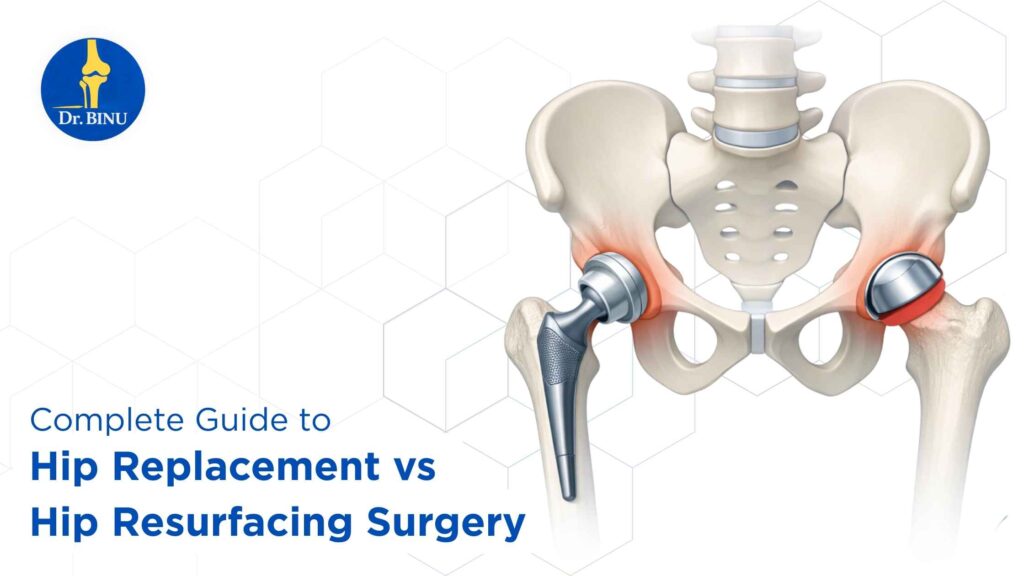
The hip resurfacing procedure overview refers to a bone-preserving surgical technique used to treat hip arthritis or joint degeneration. Instead of removing the entire femoral head (the ball of the hip joint), the surgeon reshapes it and covers it with a smooth metal cap.
The socket portion of the hip joint is also fitted with a metal lining, allowing the joint to move smoothly again. This approach preserves more natural bone compared to total hip replacement.
Key features of hip resurfacing
- Preserves most of the femoral bone
- Uses a metal cap instead of replacing the entire joint head
- Designed to mimic natural joint mechanics
- Often recommended for younger or more active individuals
Dr. Binu Sasidharan carefully evaluates patient anatomy, activity level, and overall joint health before recommending this approach.
What is total hip replacement surgery?
Total hip replacement surgery is one of the most successful procedures in orthopaedic medicine. In this surgery, the damaged hip joint is removed and replaced with an artificial prosthetic joint consisting of a metal or ceramic ball and a durable socket.
Patients experiencing severe osteoarthritis, rheumatoid arthritis, or traumatic hip injury often benefit from this procedure.
Components used in hip replacement
- Artificial femoral stem inserted into the thigh bone
- Metal or ceramic ball replacing the femoral head
- Artificial socket lining placed in the hip bone
- High-durability materials designed for long-term function
With modern surgical techniques and advanced implants, hip replacement surgery outcomes have improved significantly, offering pain relief and restored mobility for most patients.
Hip resurfacing vs total hip replacement surgery: key differences
The decision between procedures often involves comparing hip resurfacing vs total hip replacement surgery. Although both surgeries address hip joint degeneration, the surgical technique and long-term considerations differ.
| Factor | Hip resurfacing | Total hip replacement |
|---|---|---|
| Bone preservation | Preserves most of femoral bone | Removes femoral head |
| Implant design | Metal cap and metal socket | Stem, ball, and socket prosthesis |
| Recommended age | Often younger active patients | Wider age range |
| Revision possibility | Easier conversion to replacement later | Revision possible but more complex |
| Activity level | Often preferred for high activity | Suitable for moderate activity |
Hip resurfacing vs hip replacement benefits
Both procedures provide pain relief and restore joint function, but there are distinct hip resurfacing vs hip replacement benefits that influence surgical recommendations.
Benefits of hip resurfacing
- Preserves more natural bone structure
- Lower risk of hip dislocation due to larger joint head
- Often preferred for physically active individuals
- Potentially easier revision surgery later in life
Benefits of hip replacement
- Well-established surgical procedure
- Suitable for a wider range of patients
- Excellent long-term reliability
- Effective for severe joint damage
With more than two decades of orthopaedic experience, Dr. Binu Sasidharan carefully discusses these benefits with patients before determining the most appropriate surgical option.
Hip resurfacing vs hip replacement complications
Like any surgical intervention, both procedures carry potential risks. Understanding hip resurfacing vs hip replacement complications helps patients make informed decisions.
Possible complications of hip resurfacing
- Femoral neck fracture
- Metal ion release in rare cases
- Implant loosening
- Allergic reaction to metal components
Possible complications of hip replacement
- Joint dislocation
- Infection
- Blood clots
- Implant wear over time
Dr. Binu Sasidharan follows internationally recognized safety protocols, meticulous surgical techniques, and strict infection control practices to minimize these risks.
Hip resurfacing vs hip replacement recovery time
Recovery after surgery varies depending on the procedure performed, overall patient health, and rehabilitation adherence. Comparing hip resurfacing vs hip replacement recovery time helps patients understand what to expect during rehabilitation.
Typical recovery timeline
- Hospital stay: 1–3 days
- Walking with support: within 24–48 hours
- Physiotherapy begins immediately
- Return to daily activities: 4–8 weeks
- Full recovery: 3–6 months
Hip resurfacing patients sometimes regain high-impact mobility faster due to preserved bone structure, while hip replacement patients may require slightly longer rehabilitation.
Dr. Binu Sasidharan provides structured post-operative rehabilitation programs to ensure optimal recovery and long-term joint performance.
Hip resurfacing implant longevity
One important factor in surgical planning is hip resurfacing implant longevity. Modern resurfacing implants are designed to last many years, especially when used in carefully selected patients.
Similarly, modern hip replacement implants can function for 15–25 years or longer depending on activity level, body weight, and implant material.
Advances in orthopaedic implant technology, including improved metallurgy and bearing surfaces, have significantly enhanced durability and patient outcomes.
Hip replacement surgery outcomes
Clinical data consistently shows excellent hip replacement surgery outcomes. Most patients experience significant pain relief, improved mobility, and a better quality of life.
Studies report that more than 90% of hip replacement implants remain functional for over 15 years. When performed by experienced orthopaedic surgeons such as Dr. Binu Sasidharan, outcomes are typically highly favorable.
Expected improvements after surgery
- Reduced chronic hip pain
- Improved walking ability
- Better joint stability
- Enhanced participation in daily activities
- Greater independence and mobility
Who is a candidate for hip surgery?
Patients suffering from advanced joint damage may be candidates for either procedure. Conditions that often lead to surgery include:
- Severe osteoarthritis
- Hip joint degeneration
- Traumatic injury to the hip
- Chronic pain affecting mobility
- Limited response to non-surgical treatment
During consultation, Dr. Binu Sasidharan performs detailed clinical examination and imaging studies to determine the most appropriate treatment strategy.
How Dr. Binu Sasidharan approaches hip joint surgery
Dr. Binu Sasidharan Neelakantan is a Specialist Orthopaedic Surgeon practicing in Abu Dhabi with over 20 years of experience in joint replacement, sports medicine, and trauma surgery.
His surgical approach focuses on:
- Accurate diagnosis and patient evaluation
- Evidence-based surgical planning
- Minimally invasive techniques where appropriate
- Advanced arthroplasty and joint reconstruction
- Comprehensive post-operative rehabilitation
Patients receive individualized treatment recommendations based on their anatomy, activity level, and long-term health goals.
About Dr. Binu Sasidharan
Dr. Binu Sasidharan Neelakantan is a Specialist Orthopaedic Surgeon based in Abu Dhabi, UAE. He currently practices at NMC Specialty Hospital, Electra, where he provides advanced musculoskeletal care including joint replacement surgery, sports injury management, trauma surgery, and arthroscopy.
With fellowships in arthroplasty and knee arthroscopy and additional qualifications in healthcare quality and patient safety, Dr. Binu integrates surgical expertise with internationally recognized healthcare standards.
His commitment to patient education, personalized treatment plans, and evidence-based medicine has made him a trusted orthopaedic surgeon for patients seeking reliable joint care in the UAE.
Frequently Asked Questions
Understanding hip replacement vs hip resurfacing surgery is important when evaluating treatment options for advanced hip arthritis or joint degeneration. In a total hip replacement procedure, the damaged hip joint is removed and replaced with an artificial implant consisting of a socket and stem component.
In contrast, hip resurfacing preserves more of the patient’s natural bone by trimming and capping the femoral head with a metal covering while placing a matching socket in the pelvis. This bone-conserving approach can be beneficial for certain patients, particularly younger and active individuals.
When discussing hip replacement vs resurfacing surgery explained, orthopedic specialists like Dr. Binu Sasidharan carefully evaluate age, bone quality, lifestyle demands, and the severity of joint damage to recommend the most suitable surgical approach.
The discussion around hip resurfacing vs total hip replacement surgery often focuses on lifestyle and activity levels. Hip resurfacing may be more suitable for younger and physically active patients because it preserves more natural bone structure and can provide greater joint stability during high-impact activities.
Total hip replacement remains the most widely performed procedure and offers excellent pain relief and long-term results for many patients, especially those with significant joint damage or reduced bone quality.
During consultation, Dr. Binu Sasidharan evaluates mobility requirements, joint health, and imaging results to determine whether hip resurfacing vs total hip replacement surgery is the more appropriate choice for the individual patient.
When comparing hip resurfacing vs hip replacement benefits, each procedure offers unique advantages depending on the patient's condition. Hip resurfacing allows preservation of more natural bone, which can be beneficial for younger individuals who may require future revision surgery.
Additionally, hip resurfacing may provide a greater range of motion and lower risk of dislocation due to the larger size of the joint surface used in the procedure.
On the other hand, traditional hip replacement surgery outcomes are highly predictable and widely studied, making the procedure suitable for a broader range of patients including older individuals or those with severe joint degeneration.
An experienced orthopedic surgeon like Dr. Binu Sasidharan helps patients weigh hip resurfacing vs hip replacement benefits carefully before choosing the optimal treatment.
The hip resurfacing vs hip replacement recovery time can vary based on surgical technique, patient health, and adherence to rehabilitation protocols. In general, both procedures involve a structured physiotherapy program that begins soon after surgery.
Some patients undergoing hip resurfacing may experience faster functional recovery because more of the natural bone structure is preserved. However, recovery timelines are influenced by multiple factors including age, muscle strength, and pre-surgery mobility.
Patients treated by Dr. Binu Sasidharan receive individualized rehabilitation plans designed to restore mobility safely while minimizing complications and improving long-term joint performance.
Like all orthopedic procedures, there are potential hip resurfacing vs hip replacement complications that patients should understand. With hip resurfacing, concerns may include metal ion release or femoral neck fracture in rare cases.
In total hip replacement, complications may include implant wear, dislocation, infection, or loosening over time. However, advancements in surgical techniques and implant materials have significantly improved safety and success rates.
Dr. Binu Sasidharan carefully evaluates patient suitability for each procedure and uses modern surgical protocols to minimize the risk of hip resurfacing vs hip replacement complications while ensuring optimal outcomes.
Hip resurfacing implant longevity depends on factors such as patient activity levels, bone quality, surgical precision, and implant design. Modern hip resurfacing systems are designed to provide durable performance for many years when properly selected for the right candidates.
Studies suggest that hip resurfacing implants can last well over a decade or longer in appropriately selected patients, particularly younger individuals with strong bone density.
Through careful patient evaluation and surgical expertise, Dr. Binu Sasidharan aims to maximize hip resurfacing implant longevity while maintaining joint stability and functional mobility.
Hip replacement surgery outcomes are generally very successful, with most patients experiencing significant pain relief, improved mobility, and enhanced quality of life. The procedure is considered one of the most reliable orthopedic surgeries worldwide.
Modern implants and minimally invasive techniques have improved the durability and function of hip replacements, allowing patients to return to many daily activities with greater comfort.
Under the care of Dr. Binu Sasidharan, patients benefit from advanced surgical techniques, personalized rehabilitation, and long-term follow-up to ensure the best possible hip replacement surgery outcomes.
A hip resurfacing procedure overview typically includes the removal of damaged cartilage from the hip joint while preserving the natural femoral head. The bone surface is then reshaped and capped with a smooth metal covering, while the hip socket receives a matching metal cup.
This approach maintains much of the patient’s original bone structure and may allow greater joint stability for certain individuals.
Dr. Binu Sasidharan provides a detailed hip resurfacing procedure overview during consultation so patients fully understand surgical steps, recovery expectations, and how the procedure compares with hip replacement vs hip resurfacing surgery options.
