
How to decide between hip replacement and hip resurfacing surgery
Choosing between hip replacement and hip resurfacing surgery depends on multiple factors including age, activity level, bone quality, and long-term goals. Understanding the hip replacement vs hip resurfacing explained approach helps patients make informed decisions based on medical evidence and expert guidance.
When facing chronic hip pain or reduced mobility, many patients find themselves navigating complex orthopedic hip surgery choices. With the guidance of an experienced specialist like Dr. Binu Sasidharan, patients receive personalized insights that align with their lifestyle, medical condition, and recovery expectations.
What is the difference between hip replacement and resurfacing surgery?
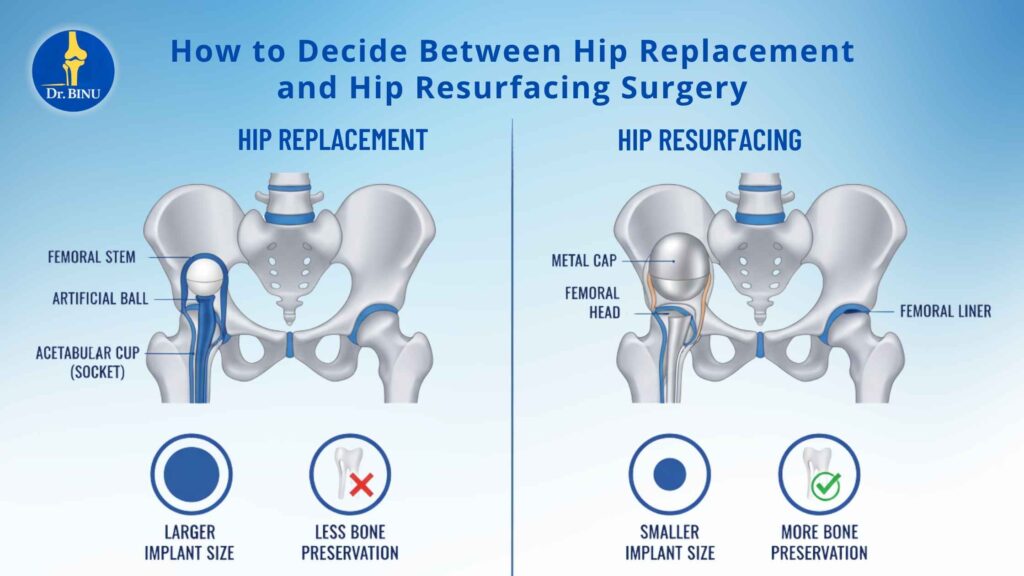
The difference between hip replacement and resurfacing surgery lies primarily in how much of the natural bone is preserved and how the joint is reconstructed.
- Hip replacement surgery: The damaged hip joint is removed and replaced with artificial components.
- Hip resurfacing: The femoral head is reshaped and capped with a metal prosthesis while preserving more bone.
This distinction is critical when evaluating hip joint replacement alternatives, especially for younger or more active individuals who may benefit from bone preservation techniques.
Why is choosing the right hip surgery important?
Selecting the appropriate procedure is essential for long-term joint function, durability, and patient satisfaction. A well-structured hip surgery decision guide considers not only current symptoms but also future activity levels and revision risks.
Dr. Binu Sasidharan emphasizes individualized hip surgery treatment planning to ensure that each patient receives the most suitable intervention based on clinical findings and personal goals.
Hip resurfacing vs hip replacement pros and cons
Understanding the hip resurfacing vs hip replacement pros and cons is key to making a confident decision.
| Factor | Hip Replacement | Hip Resurfacing |
|---|---|---|
| Bone Preservation | Less preservation | More preservation |
| Durability | Excellent for older patients | Ideal for younger active patients |
| Risk of Dislocation | Moderate | Lower |
| Revision Surgery | More complex | Easier due to preserved bone |
| Suitability | Older or less active individuals | Younger, active individuals with strong bone quality |
This hip surgery options comparison helps patients weigh benefits and limitations clearly under expert supervision.
Who is the ideal candidate for each procedure?
Ideal candidates for hip replacement
- Patients above 60 years
- Individuals with severe arthritis or joint degeneration
- Patients with weaker bone density
- Those seeking reliable pain relief and improved mobility
Ideal candidates for hip resurfacing
- Younger patients (typically under 60)
- Active individuals or athletes
- Patients with strong bone quality
- Those looking to maintain higher activity levels post-surgery
Dr. Binu’s hip resurfacing consultation guide ensures that every candidate is carefully evaluated using advanced imaging, clinical assessment, and functional analysis.
How does lifestyle affect the decision?
Lifestyle plays a major role in determining the most suitable surgical option. Active individuals who wish to return to sports or physically demanding activities may benefit more from hip resurfacing. On the other hand, patients prioritizing long-term reliability with minimal risk may lean toward total hip replacement.
Through detailed hip surgery treatment planning, Dr. Binu assesses:
- Daily activity levels
- Occupational demands
- Fitness goals
- Recovery expectations
What are the risks associated with each procedure?
Both procedures are safe when performed by experienced surgeons, but each carries specific risks.
Hip replacement risks
- Dislocation
- Wear and tear over time
- Infection
- Need for revision surgery
Hip resurfacing risks
- Metal ion release in rare cases
- Femoral neck fracture
- Limited suitability for certain patients
A comprehensive hip surgery decision guide includes a transparent discussion of these risks, helping patients make informed choices.
How does recovery differ between the two surgeries?
Recovery timelines vary slightly depending on the procedure and patient condition.
- Hip replacement: Recovery typically takes 6–12 weeks for basic mobility, with gradual return to normal activities.
- Hip resurfacing: Often allows faster return to high-impact activities due to preserved bone structure.
Dr. Binu integrates rehabilitation protocols tailored to each patient, ensuring optimal recovery outcomes.
What role does surgeon expertise play in decision making?
The success of either procedure is highly dependent on the surgeon’s expertise. Dr. Binu Sasidharan brings over 20 years of experience in arthroplasty and sports medicine, offering advanced techniques and evidence-based care.
His approach to orthopedic hip surgery choices includes:
- Detailed diagnostic evaluation
- Patient-centered consultations
- Minimally invasive surgical techniques
- Post-operative rehabilitation planning
How to choose the best option for your condition?
Choosing between procedures involves a structured approach:
- Understand your diagnosis and severity
- Evaluate your age and activity level
- Discuss hip joint replacement alternatives with your surgeon
- Review imaging and clinical findings
- Consider long-term outcomes and revision possibilities
- Follow a personalized hip surgery decision guide
With expert input from Dr. Binu, patients can confidently select the most appropriate treatment path.
About Dr. Binu Sasidharan
Dr. Binu Sasidharan Neelakantan is a Specialist Orthopaedic Surgeon based in Abu Dhabi, UAE, with over 20 years of experience in joint replacement, arthroscopy, and trauma care. Practicing at NMC Specialty Hospital, he is known for delivering patient-focused, evidence-based orthopaedic care.
His expertise includes:
- Hip replacement surgery
- Joint reconstruction
- Sports injury management
- Advanced arthroplasty techniques
With international training and certifications in healthcare quality and patient safety, Dr. Binu ensures that every patient receives world-class treatment tailored to their needs.
Conclusion
Deciding between hip replacement and hip resurfacing surgery requires a comprehensive understanding of the difference between hip replacement and resurfacing surgery, combined with expert medical advice. By evaluating individual needs through a structured hip surgery options comparison, patients can achieve optimal outcomes and long-term joint health.
With guidance from Dr. Binu Sasidharan, patients benefit from precise diagnosis, personalized care, and advanced surgical solutions that restore mobility and improve quality of life.
Frequently Asked Questions
When discussing hip replacement vs hip resurfacing explained, the key difference lies in how much of the natural bone is preserved. Hip replacement involves removing the damaged joint and replacing it with an artificial implant, while hip resurfacing reshapes and caps the existing bone. Dr. Binu Sasidharan carefully evaluates each patient to determine which option aligns best with their age, lifestyle, and joint condition.
The difference between hip replacement and resurfacing surgery mainly involves the extent of bone removal and implant design. Hip replacement removes the femoral head entirely, while resurfacing preserves it and covers it with a metal cap. Dr. Binu Sasidharan explains these differences during consultations to help patients make informed decisions based on mobility goals and long-term outcomes.
A hip surgery decision guide helps you weigh factors like age, activity level, bone health, and expectations after surgery. Dr. Binu Sasidharan provides a structured approach that simplifies complex medical choices, ensuring that patients understand the risks, benefits, and recovery timelines before proceeding with surgery.
Understanding hip resurfacing vs hip replacement pros and cons is essential. Hip resurfacing preserves more bone and may suit younger, active individuals, while hip replacement offers predictable results for a broader range of patients. Dr. Binu Sasidharan helps patients evaluate durability, recovery time, and activity limitations to select the most suitable procedure.
A proper hip surgery options comparison includes evaluating implant longevity, surgical risks, recovery speed, and future revision possibilities. Dr. Binu Sasidharan emphasizes personalized care, ensuring that each patient’s medical history and lifestyle are factored into the comparison process.
Choosing between orthopedic hip surgery choices requires expert evaluation and patient education. Dr. Binu Sasidharan guides patients through imaging results, physical assessments, and lifestyle considerations to recommend the most effective and safe surgical path.
Yes, hip joint replacement alternatives such as hip resurfacing may be suitable for select patients, especially younger individuals with strong bone quality. Dr. Binu Sasidharan evaluates whether patients qualify for these alternatives and explains their benefits and limitations clearly.
Hip surgery treatment planning involves a comprehensive review of symptoms, imaging studies, and overall health. Dr. Binu Sasidharan creates customized treatment plans that include preoperative preparation, surgical technique selection, and post-surgical rehabilitation strategies for optimal recovery.
A hip resurfacing consultation guide session typically includes a detailed discussion of your medical history, imaging analysis, and suitability for the procedure. Dr. Binu Sasidharan ensures that patients understand every aspect of the surgery, including expected outcomes, risks, and recovery timelines, before making a final decision.
